First think together. Then build together.
Last year, around this time, I wrote about a question that had been sitting with me for a while: what if India's startups could think together?
The idea was simple. Somewhere in India, a founder is about to make the same mistake that already killed a hundred startups before them. Not because they are careless, and not because they lack ambition, but because the learning is trapped elsewhere: in an incubator's spreadsheet, a mentor's memory, an investor's notes, a failed founder's experience.
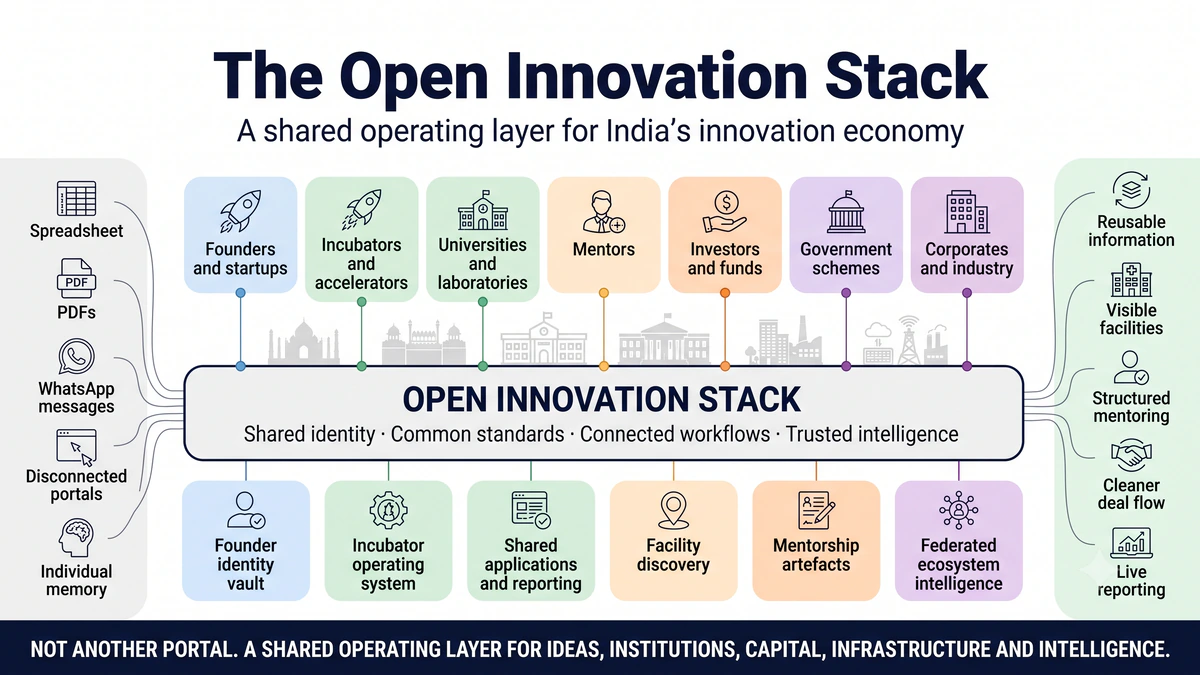
That article argued for a unified startup data platform, a way for India's startup ecosystem to become more intelligent, more connected, and less wasteful. A year later, I think the idea needs to evolve. The real opportunity is not a startup data platform. It is an Open Innovation Stack: a shared operating layer for India's innovation economy.
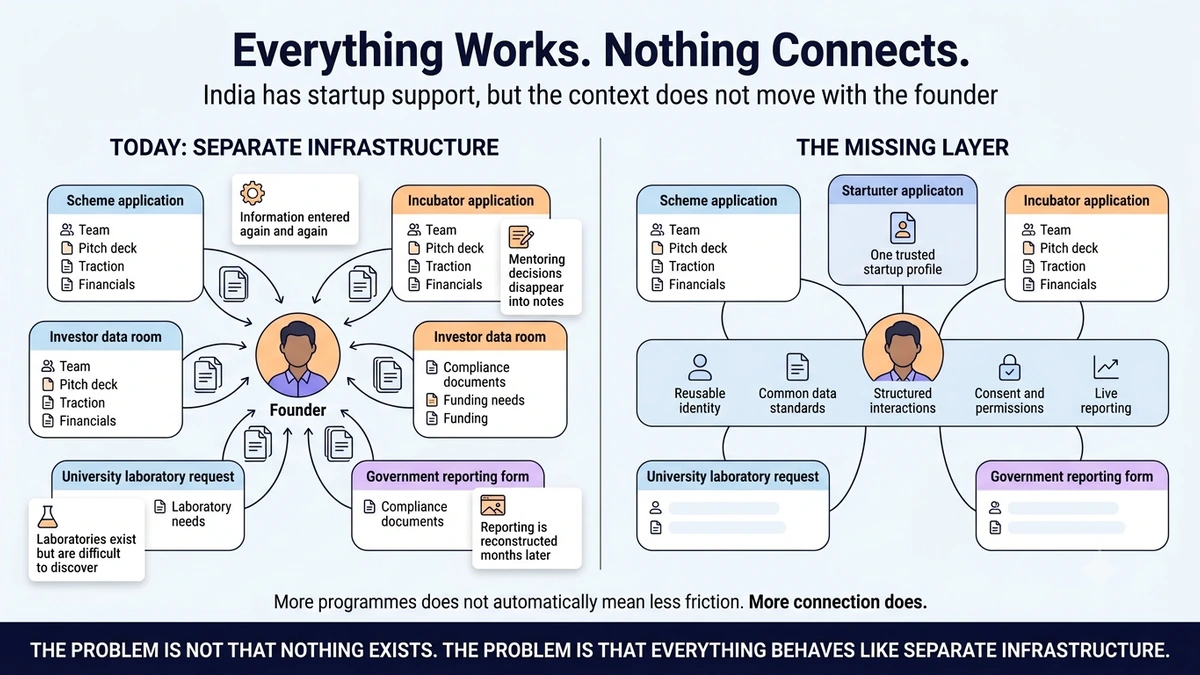
The Gap: Everything Works, Nothing Connects
India does not lack startup energy. We have founders, incubators, accelerators, schemes, grants, labs, mentors, investors, universities, CSR capital, and government ambition. The problem is that all of this still behaves like separate infrastructure.
- A founder applies to one scheme, then another, then an incubator, then a fund, re-entering the same information every time.
- An incubator supports hundreds of startups but runs critical workflows on Google Sheets, PDFs, WhatsApp, and memory.
- A mentor gives advice that may change the course of a company, but three months later no one can say what was decided, what was done, or whether it worked.
- A university has world-class labs and faculty expertise that founders outside the institution will never discover.
- A government department knows how much money was disbursed, but not which intervention actually changed outcomes.
Everyone is working hard. But the system is not yet learning as a system.
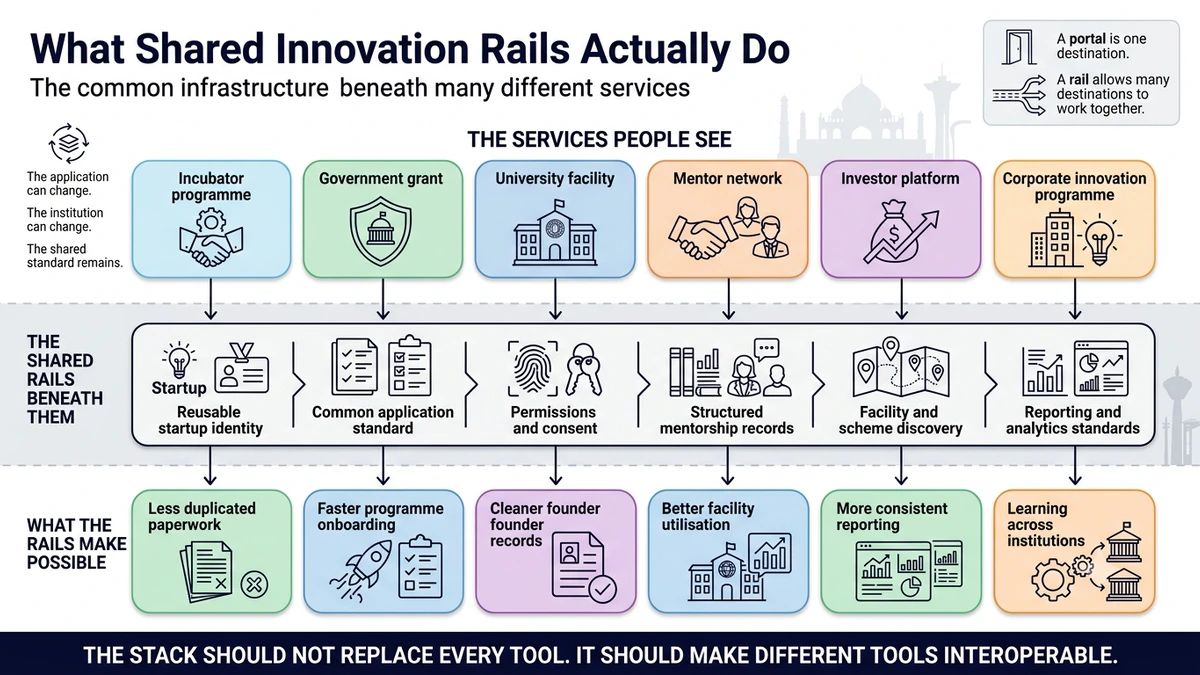
The Pattern: Mature Economies Build Rails
Every mature economy eventually builds rails. Payments needed rails, and India built UPI. Identity needed rails, and India built Aadhaar. Digital documents needed rails, and India built DigiLocker. Commerce, credit, health, and education are all moving toward shared digital infrastructure.
Innovation support still has no common operating layer.
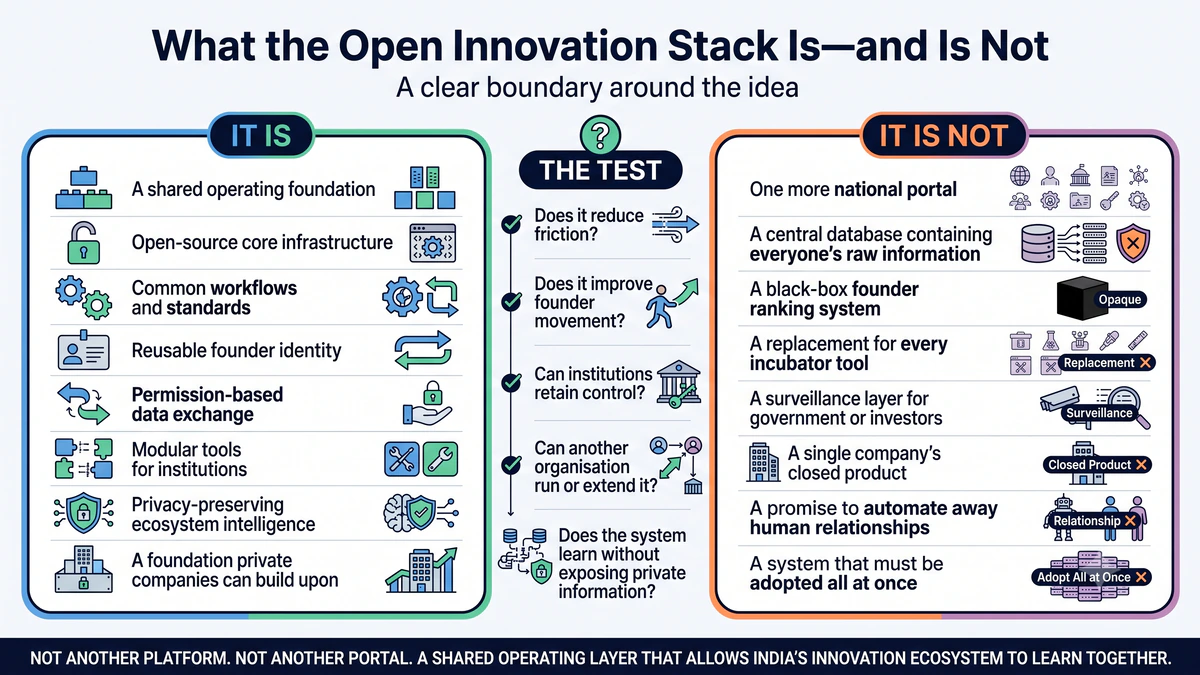
That is what the Open Innovation Stack could become. Not one more portal. Not one more dashboard. Not one more private SaaS tool sold only to already-resourceful institutions. A shared, open-source foundation that any incubator, university, accelerator, state startup mission, facility, fund, or innovation cell can run.
The floor is free. The services on top can be paid. The standard is open. The learning compounds.
The Vision: What Connected Looks Like
Imagine:
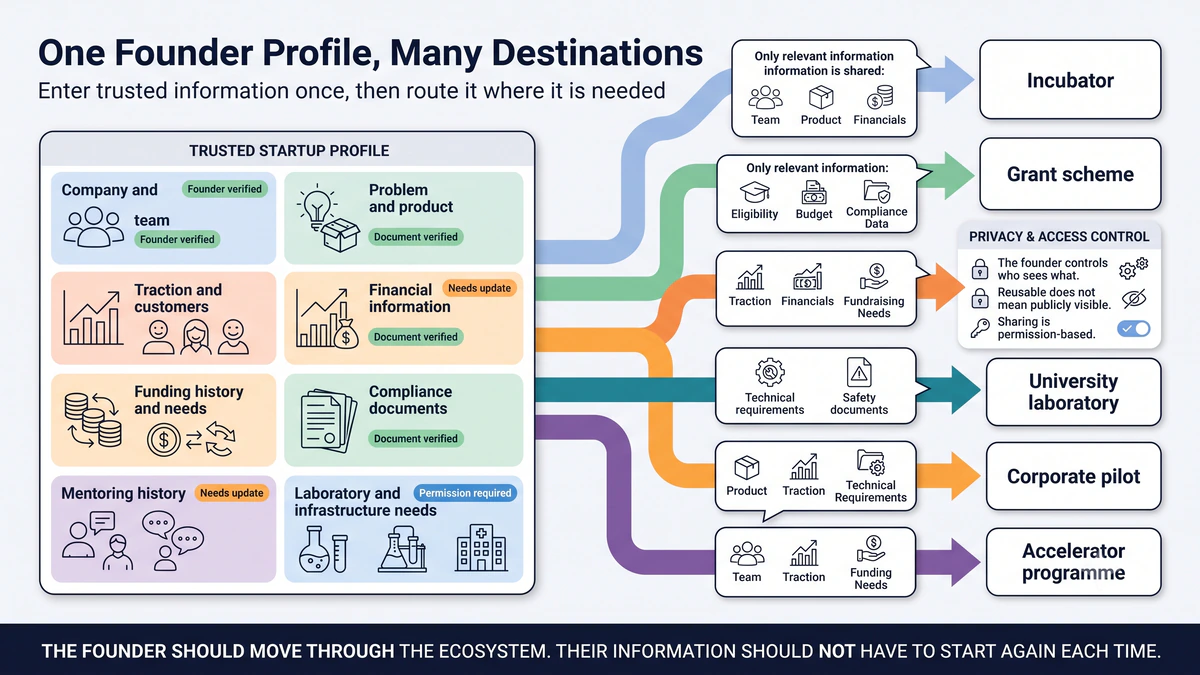
- A founder creates one trusted startup profile (team, traction, pitch, documents, compliance, funding needs, lab needs) and routes it to every participating scheme, incubator, fund, or program.
- An incubator moves from spreadsheets to a real operating system in weeks, not years.
- Every mentor session produces a usable artifact: decisions, risks, action items, milestones, follow-up.
- A founder in a tier-2 city searches for a lab, instrument, grant, mentor, or investor without needing to know someone who knows someone.
- Government scheme reporting becomes a live query, not a two-month Excel reconstruction exercise.
- Investors see cleaner, standardised, benchmarked deal flow from beyond their existing networks.
- Universities make their faculty, facilities, research, IP, and startup support visible to the whole country.
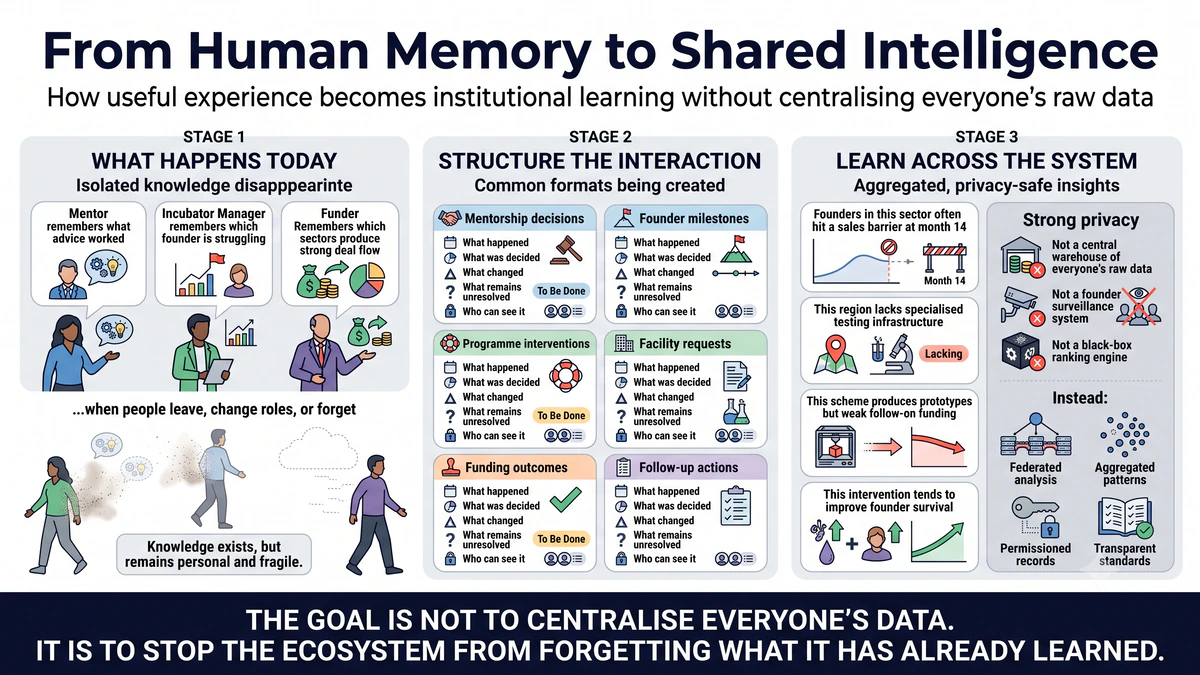
And imagine the system detecting patterns early. Founders in this sector usually hit a go-to-market wall at month 14. Deep-tech teams in this region are strong technically but lack testing facilities. This scheme produces strong prototypes but weak follow-on funding. These startups are showing distress signals, and the right mentor intervention could still help.
That is not science fiction. That is what happens when an ecosystem stops operating as scattered programs and starts operating as connected infrastructure.
The Shift: From Memory to Shared Intelligence
Right now, much of India's startup ecosystem runs on human memory. A mentor remembers what worked. An incubator manager remembers which founder is struggling. A funder remembers which region has strong deal flow. Memory is powerful, but memory does not scale.
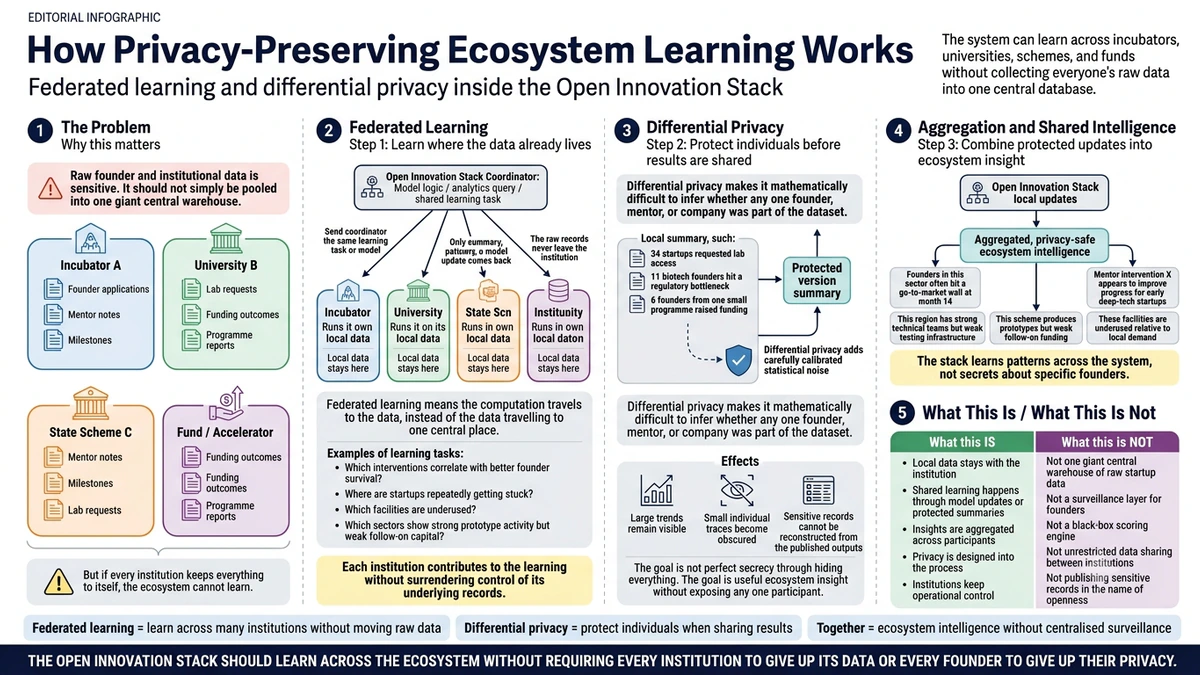
The Open Innovation Stack turns memory into shared intelligence. Not by centralising everyone's raw data. Not by creating a surveillance layer. Not by ranking founders through some black-box score. It does this through common workflows, common standards, reusable identity, structured interactions, and privacy-preserving analytics. The system learns without any participant giving up control.
This matters because the next phase of Indian innovation will be harder than the last one. It will not only be consumer apps and SaaS. It will be biotech, climate, advanced manufacturing, medical devices, semiconductors, robotics, AI, and space. These companies need more than capital. They need labs, patient mentoring, regulatory support, testing infrastructure, university partnerships, and long-term ecosystem memory. A fragmented support system will not be enough.
The Trust Test: Open by Design
If this is going to become ecosystem infrastructure, it cannot be locked inside one company's product roadmap. It has to be trusted.
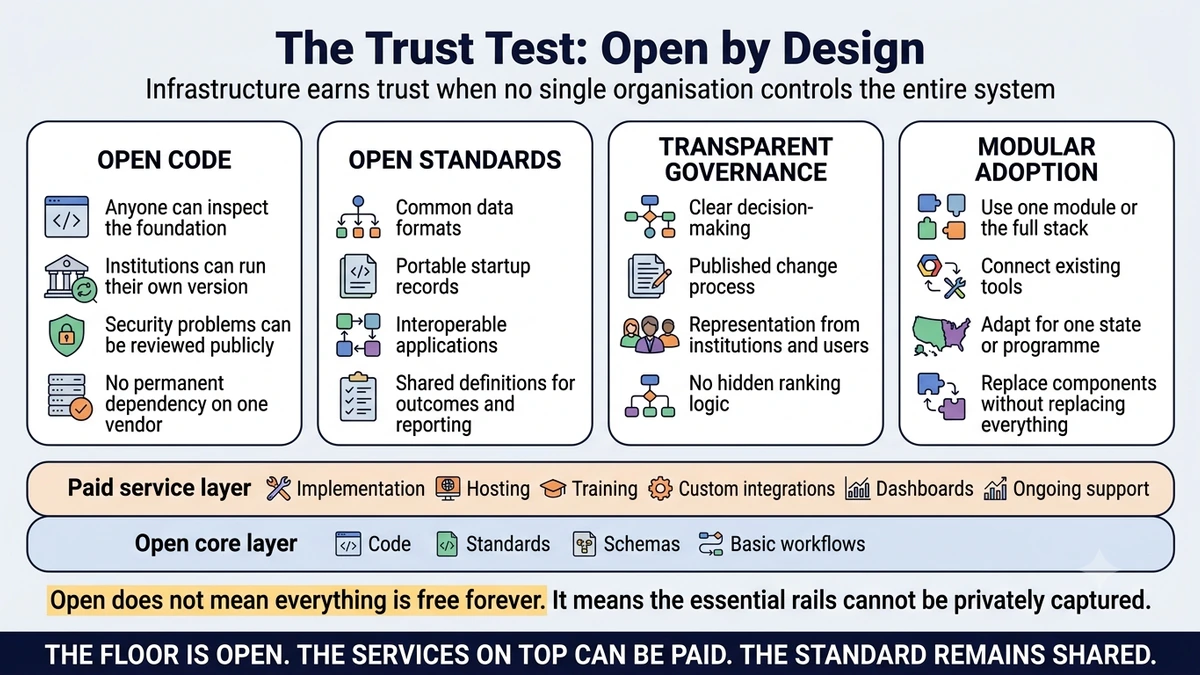
That means open code, open standards, transparent governance, and modular adoption. Any incubator should be able to run it. Any state should be able to adapt it. Any university should be able to contribute. Any private player should be able to build services on top.
One important distinction: open does not mean everything is free forever. The core rails should be open. Implementation, hosting, training, dashboards, integrations, and advanced analytics create the business model. That is how the stack sustains itself without becoming extractive.
The Value: ₹25,000 Crore, Revisited
Last year, I argued that a unified platform could unlock ₹25,000 crore by 2030 by reducing avoidable failures and improving capital allocation. I still believe that number. But I now think the path to it is clearer, and it does not come only from better analytics. It comes from removing friction across the entire innovation journey: less time filling forms, less time lost in compliance, less duplication across schemes, less underutilised lab infrastructure, less invisible research, less forgotten mentoring, and less policy designed through delayed reports.
The value is not only in the data. The value is in making the whole system easier to move through.
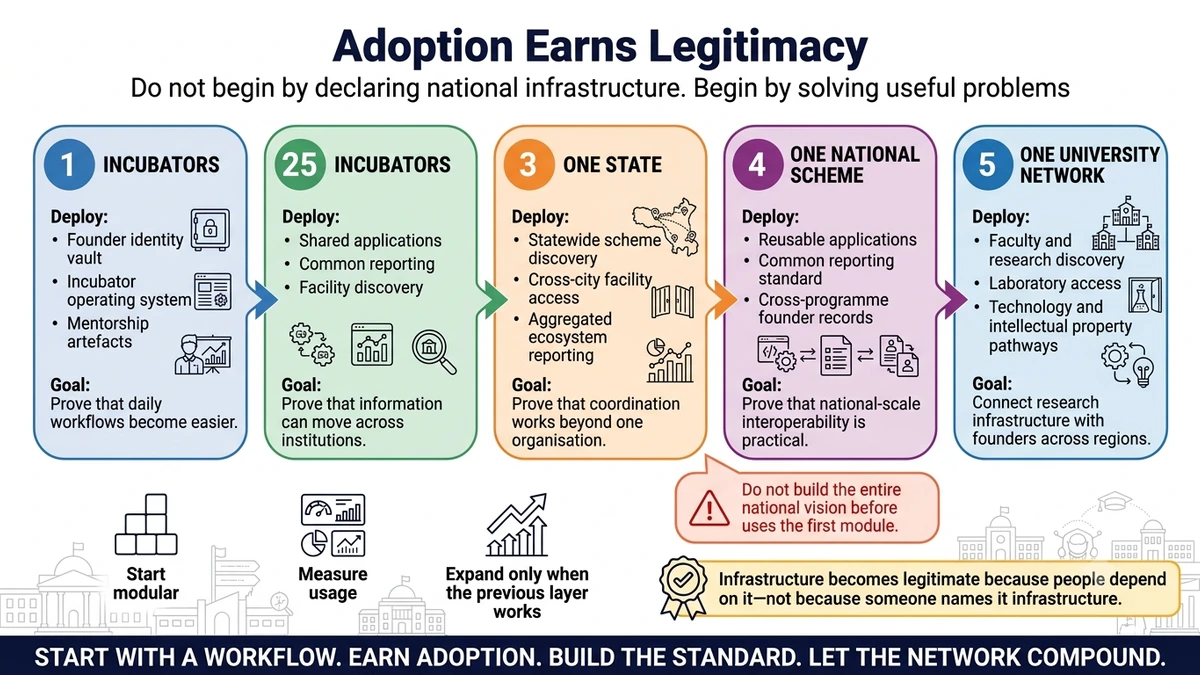
The Path: Adoption Earns Legitimacy
We do not need to build the entire national stack on day one. We can begin with a few practical layers:
- A founder identity vault
- An incubator operating system
- A shared application and reporting standard
- A national facility discovery layer
- A mentorship artifact system
- A federated intelligence layer that publishes only aggregated, privacy-safe insights
Start with five incubators, then 25, then one state, then one national scheme, then one university network. Adoption should earn legitimacy, not the other way around. If it works, it becomes infrastructure because people use it, not because someone declared it infrastructure.
The Question, One Year Later
The question is no longer whether India needs more startup support. We have support. The question is whether that support can become connected enough to compound. Can one founder's lesson help the next founder? Can one mentor's insight become institutional memory? Can one lab's unused capacity become another startup's breakthrough? Can one incubator's workflow become a shared standard for hundreds more?
Can India's innovation ecosystem become not just bigger, but smarter?
That is the promise of the Open Innovation Stack. Not another platform. Not another portal. A shared operating layer for ideas, institutions, capital, infrastructure, and intelligence.
The next leap in India's startup ecosystem will not come only from more founders starting up. It will come from making sure the system around them finally learns fast enough to keep up.
If you run an incubator, a university innovation cell, a state mission, a fund, or a scheme and you want to help build this, let's talk.
Acknowledgements
- Vidit Bhatia for being my coding guru
- Krish Chittmalla for co-developing the Open Innovation Stack vision and pushing beyond challenges
- Pankaj Chandra for believing in my leadership abilities