The exchange — one folder between a founder and a programme
The connection between a founder's stack and a programme's record is a shared folder with two subfolders in it. That is the whole mechanism, and it is deliberately the dullest part of the design.
Read for-portfolios.md first if you have not — this page is the contract, not the reasoning.
Why a folder and not an integration
Because the alternative is worse in every way that matters.
A shared folder works on whatever the programme and the founder already run. It survives a founder leaving the programme, a programme changing tools, and a coach who will not learn a new system. It can be inspected by both sides at any time, which is the property that makes a data conversation possible at all — here is the folder, that is everything we exchange, look at it.
Most importantly, a folder can hold nothing more than it holds. An integration that reads a founder's drive is a permission that grows. This does not.
The folder
One per member company. The programme creates it and adds the founder. Both sides can see all of it.
<company-slug>/
  README.md              what this is, who reads which side, how long it is kept
  from-founder/          the founder's carved brief — the programme reads, never writes
  from-programme/        session records — the founder reads, never writes
Three rules make it work, and all three are the same rule from different sides:
Neither master lives here. The founder's stack stays on the founder's storage. The programme's record stays in the programme's portfolio/. What lands in the shared folder is a copy, produced by a carve, sent deliberately.
Each side treats the other's directory as read-only evidence. Exactly as _inbox/ already works in a founder's stack: you read it, you cite it, you never write into it. If you disagree with something in the other side's folder, you say so in your own — you do not edit theirs.
Everything is markdown with front matter. Same schema as everywhere else in this repo, so both sides' AI tools can route through it without being taught anything new.
Going in — from-founder/
The founder's carved brief. Not their stack, not their CONTEXT.md verbatim — the version they chose to send.
It comes from the carve that already exists. prompts/12-weekly-recap.md Step 7 has presets for coach, team and investors; the PROGRAMME preset is the fourth. What it sends:
- the current one-pager: what the company is, who the customer is, what they are trying to do next
- this week's metrics and what moved
- what did not get done, and why
- what they are stuck on and what they want help with
restricted never travels, under any preset. internal travels only because the founder said so — and the carve output states what it withheld, so the founder can see the shape of what they are not sending.
<company-slug>/from-founder/
  context.md                 the one-pager, refreshed when it changes
  2026-07-24-recap.md        the weekly carve, dated, append-only
Front matter on anything the founder sends:
---
doc: recap-carve
subject: acme-widgets
audience: programme
owner: "[the founder's name]"
updated: 2026-07-24
status: needs-verification
confidence: medium
sensitivity: internal
summary: Week ending 24 July. Metrics, what moved, what did not, the one thing
  they want help with.
---
Coming out — from-programme/
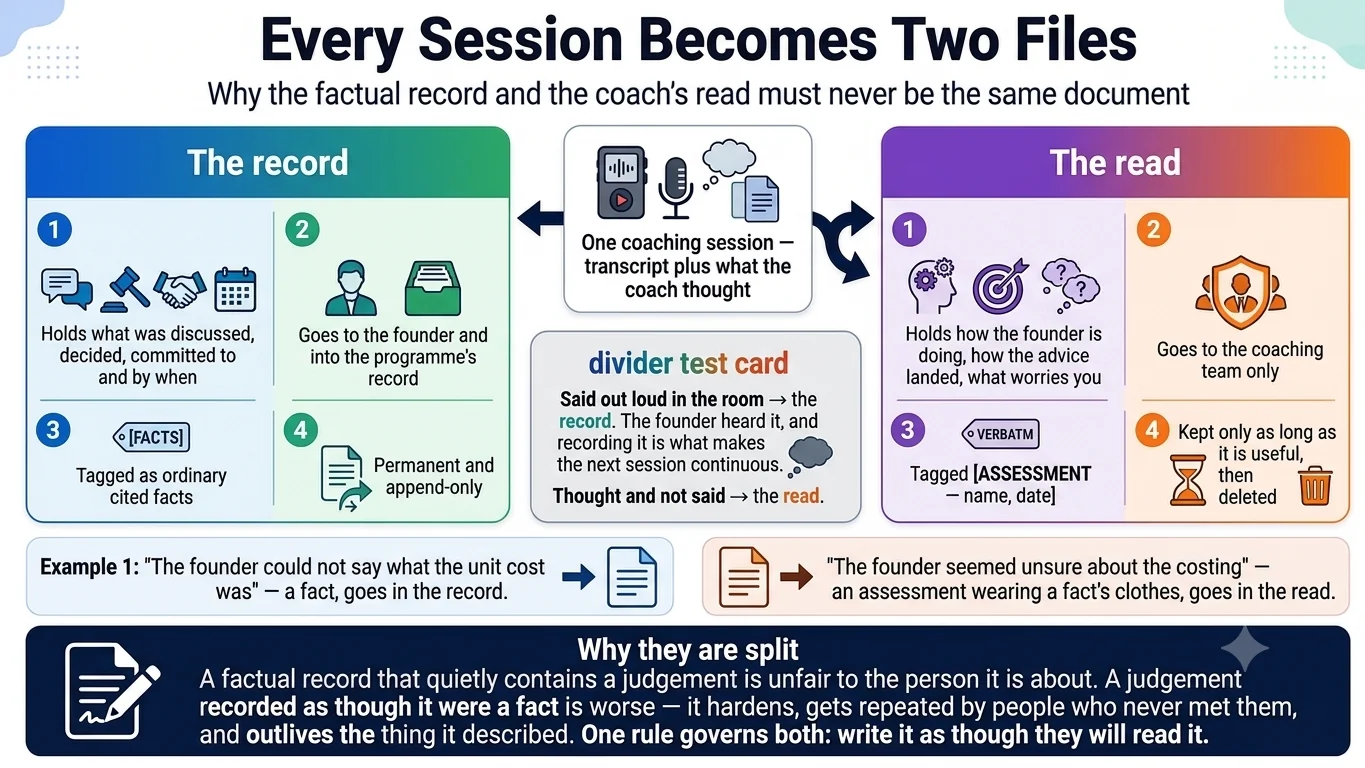
The factual half of the session record. What was discussed, what was decided, what was committed to and by when — produced by prompts/16-session-to-record.md, which splits every session into two files precisely so this one can be sent.
<company-slug>/from-programme/
  2026-07-22-session.md      the record of one session
  2026-07-22-actions.md      or the actions inline in the record, if you prefer one file
---
doc: session-record
subject: acme-widgets
audience: founder
owner: "[the coach who ran the session]"
updated: 2026-07-22
status: needs-verification
confidence: medium
sensitivity: internal
summary: Session with the operations specialist, 22 July. Costing walked
through; founder committed to three supplier quotes by 5 August.
---Send it within a day. A record that arrives a week later is a document. A record that arrives the same afternoon is a commitment, and the founder is still close enough to the conversation to correct it — which is the point, because a record they corrected is a record they agree with.
What never travels
The coach's read — audience: coach-team — stays in the programme's own portfolio/<company>/reads/. It is never copied into from-programme/, never quoted in the record, never paraphrased into it.
This is the one rule in the exchange with a mechanical check, and it should be run rather than trusted:
grep -rl "audience: coach-team" <shared-folder>/*/from-programme/That must return nothing. If it ever returns a file, the fix is not to edit the file — it is to find out how it got there, because a process that leaked once will leak again.
Note what this rule does not say. It does not say the founder must never learn what a coach thinks of them, which would be an odd thing for a coaching programme to promise. It says a judgement reaches the founder as a conversation, from the person who holds it, and not as a file they found in a folder. safety.md covers the rest, including the part where they can ask to see it anyway.
Making the folder, on whatever you already run
The folder is the same everywhere; only the provisioning differs.
| Where the folder lives | Adding the founder | |
|---|---|---|
| Microsoft 365 | A SharePoint document library, or the Files tab of a Teams channel | Guest access to that site or channel only |
| Google Workspace | A folder in a Shared Drive, or a plain Drive folder | Share with their address, editor on their own subfolder |
| Dropbox, Box, similar | A shared folder | Invite to the folder |
| None of the above | A folder in a repository the founder can push to | A collaborator on that repository |
| Nothing at all | Email attachments, in both directions | Nobody. It works, it is just manual. |
Scope the sharing to the one company's folder. A programme manager who shares the parent folder by accident has given every founder the entire portfolio, and will find out about it from the wrong person.
automation.md covers what runs on a schedule once the folder exists. Do that second — a folder both sides fill by hand for a month is a working exchange, and it tells you what to automate.
Retention, and what happens when a company leaves
Decide this when you create the folder, write it into its README.md, and say it out loud at onboarding. It takes five minutes then and is unpleasant to improvise later.
The version that covers most programmes:
This folder holds material exchanged between
[company]and[programme]. The programme keeps its own record of the sessions it ran, in its own system. The founder keeps their own stack, on their own storage. Neither is stored here.When the company leaves the programme, this folder is handed to the founder and the programme's copy is removed. The programme retains its session records for
[N]years, for[the reason]. Anything tagged[ASSESSMENT]is deleted at that point.Questions about what is held:
[named person, contact].
Two things to get right in it. Name a person, not a role and not an address that forwards to four people — the same reason every file in this repo has one named owner. And distinguish what is retained from what is deleted: session records are ordinary programme business and there are usually good reasons to keep them; a coach's read of somebody, three years after they left, is not.
Where to go next
- for-portfolios.md — the method this contract serves
prompts/16-session-to-record.md— produces what goes infrom-programme/prompts/12-weekly-recap.md— Step 7 produces what goes infrom-founder/- automation.md — running both directions on a schedule
- front-matter.md — the
subjectandaudiencefields used above
Generated from docs/exchange.md in the repository. Edit the markdown, not this page.