The maturity rubric
Ten functions, five levels each. It answers "what stage is this company really at" with something comparable across a portfolio, and it is the routing table that sends a company to the right specialist.
The functions are the ten sections of stack/. They are not a new taxonomy — reusing them is what makes a score mean the same thing in every company's folder.
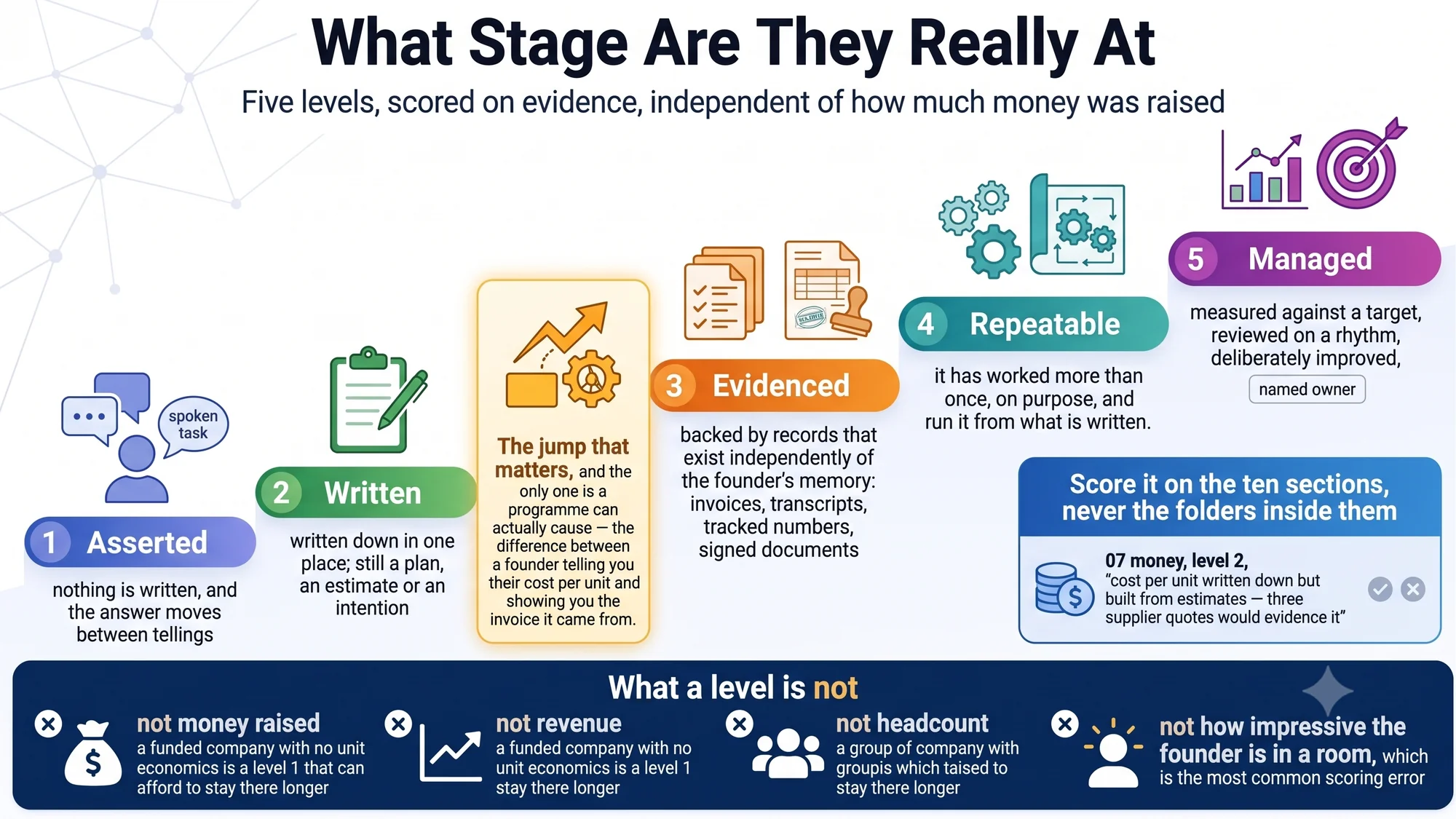
What a level is, and is not
A level describes what is observably true about how the company runs a function. It is not a judgement of the founder, and it is deliberately independent of four things people score by accident:
Money raised. A funded company with no unit economics is a level 1 on money that can afford to stay there longer. Revenue. Revenue proves someone paid. It does not prove the function is repeatable, and a company can be at level 4 on GTM with no revenue yet or at level 1 with plenty. Headcount. Twelve people running an undocumented process is a level 2, with more people in it. How impressive the founder is in a room. The most common scoring error, and the reason to score from the record rather than from the last conversation.
A low score is not a criticism. Most early companies are at 1 or 2 on most functions, and a portfolio where everyone scores 4 means the rubric is being used to flatter rather than to route.
The ladder
The same five steps everywhere. Each function's table below is this ladder made concrete.
| What has changed | ||
|---|---|---|
| 1 | Asserted | It exists as an answer the founder gives. Nothing is written, and the answer moves between tellings. |
| 2 | Written | Written down in one place. Still largely a plan, an estimate or an intention. |
| 3 | Evidenced | Backed by records that exist independently of the founder's memory — invoices, transcripts, tracked numbers, signed documents. |
| 4 | Repeatable | It has worked more than once, on purpose, and someone other than the founder could run it from what is written. |
| 5 | Managed | Measured against a target, reviewed on a rhythm, and deliberately improved. A named person owns it. |
The jump that matters most is 2 to 3, and it is the one a programme can actually cause. It is the difference between a founder telling you their cost per unit and a founder showing you the invoice it came from.
01 · Company — entity, ownership, obligations
| 1 | The founder can name the shareholders. Nothing exists beyond incorporation. |
| 2 | The cap table is written down. Equity and commission promises to advisors and contributors are verbal. |
| 3 | The written cap table matches the filed documents. Every equity promise has a signed one-page scope. |
| 4 | Compliance obligations are listed with renewal dates, and someone acts on them without being chased. |
| 5 | Cap table, filings and agreements survive a diligence request without a scramble. |
02 · Customer — who they are, and what evidence exists
| 1 | The customer is a segment: "small businesses", "young professionals". |
| 2 | An ICP and a job-to-be-done are written down, from the founder's own belief. |
| 3 | Ten or more real conversations are recorded, and the ICP has changed because of them. |
| 4 | The same objections recur predictably and each has a written answer. New interviews stop producing surprises. |
| 5 | Customer evidence is gathered continuously and visibly changes product and GTM decisions. |
03 · Market — sizing and competition
| 1 | A top-down market number from a report, quoted without its assumptions. |
| 2 | Bottom-up sizing is written down with assumptions named. Three or four competitors are listed. |
| 3 | The sizing traces to countable things. The grid includes the incumbent doing it badly and the adjacent platform that could absorb them. |
| 4 | They know who they lose to and why, from deals they actually lost. |
| 5 | Competitive position is tracked, and a competitor's price change reaches the stack in days rather than quarters. |
04 · Product — what exists versus what is a slide
| 1 | The product is described in the future tense. |
| 2 | A roadmap is written down. What exists and what is promised are not cleanly separated. |
| 3 | Something works that a real customer has used, and the written roadmap separates it from what is next. |
| 4 | They ship on a cadence. Where a consequential recommendation reaches a user, a qualified human validates it first. |
| 5 | The roadmap is driven by customer evidence rather than founder preference, and reprioritised on a rhythm. |
05 · GTM — channels and pipeline
| 1 | "Social media and word of mouth." The prospect list has five names on it. |
| 2 | Channels are named and a list exists. Mostly untested. |
| 3 | One channel has been worked properly — a hundred prospects, a recorded cadence, a result either way. |
| 4 | One channel produces customers predictably enough to plan on, and cost per acquisition is measured rather than estimated. |
| 5 | Spend is step-tested against delivery capacity, and the channel mix changes on evidence. |
06 · Operations — delivery and capacity
| 1 | The founder does it, and how it gets done lives in their head. |
| 2 | The process is written down end to end. |
| 3 | Each step is costed from real quotes and measured times, and quality checkpoints are named with an owner. |
| 4 | Someone else runs it from the written process. The capacity ceiling is known and what breaks first is named. |
| 5 | Capacity and quality are measured on a rhythm, and the constraint is managed deliberately rather than discovered. |
07 · Money — unit economics and runway
| 1 | The price is known. The cost is a feeling. |
| 2 | A cost per unit is written down, built from estimates. |
| 3 | Every line of that cost traces to an invoice, a quote or a measured time, and runway is a number with a date on it. |
| 4 | Costing exists at volume bands, working capital for the biggest realistic order is known, and CAC is measured. |
| 5 | The model updates from actuals on a rhythm, and pricing decisions are made against it. |
08 · Capital — fundraise readiness
| 1 | "We're raising", with no amount, milestone or use of funds. |
| 2 | An amount and a use of funds are written down. A deck exists. |
| 3 | The raise is tied to a named milestone, and every number in the deck matches the stack. |
| 4 | Data room assembled, dilution mapped across rounds, non-dilutive options identified and applied for. |
| 5 | Investor conversations are tracked with the reason for each pass, and the next milestone is being built toward deliberately. |
09 · Brand — name, position, system
| 1 | A name, and a logo somebody made as a favour. |
| 2 | Positioning is written in a sentence. Colours and fonts are used inconsistently. |
| 3 | A design system file exists — fonts, colours, spacing, voice — and outputs are built against it. The trademark position is known. |
| 4 | Every artifact comes out consistent without anyone specifying it, and the website and the stack say the same things. |
| 5 | Positioning is tested against how customers actually describe them, and revised when the two diverge. |
10 · Pulse — the operating rhythm
| 1 | No metrics. Progress is described in anecdotes. |
| 2 | Three to six metrics are defined. Measured occasionally. |
| 3 | A weekly recap for four consecutive weeks, including a bad one. |
| 4 | Twelve consecutive weeks. Commitments carry forward and get closed out. Every metric falls out of records already kept. |
| 5 | The recap drives decisions — things get stopped because of it, not merely reported in it. |
Scoring rules
Score from the record, not from the conversation. If nothing in sessions/ or the founder's brief evidences a level, it has not been evidenced. This is the rule that keeps the number comparable, and it is the one most often broken immediately after a good meeting.
On a tie, score down. A function halfway between 2 and 3 is a 2. The rubric is for routing, and routing a company to help it does not need does less damage than the reverse.
Score the ten sections, never the folders inside them. What a company keeps inside 04-product is its own business. That it is at level 2 on product is comparable across the portfolio, and comparability is the only reason this file exists.
Expect a jagged profile. A 4 on product and a 1 on money is normal, common, and precisely the pattern worth catching — it is a company building something good that will run out of money while building it.
Re-score quarterly, not per session. A number that moves every fortnight is measuring the coach's mood. Movement between quarters is progress you can describe to a funder without inventing a metric.
Say what would raise it. A score with no next action is a label. 2 → needs three supplier quotes so the unit cost traces to something is a task with a start date, and it is what the founder should see.
What each score routes to
The point of a low score is that it names who should see the company next, and what they should do.
| Function | Route a 1 or 2 to | What closes the gap |
|---|---|---|
| 01 company | Legal or governance | worksheets/advisor-scope.md |
| 02 customer | Customer discovery | prompts/03-customer-and-problem.md |
| 03 market | Market and competition | prompts/04-market-sizing.md, 05, 15 |
| 04 product | Product and technology | prompts/06-product-and-roadmap.md |
| 05 gtm | Sales and growth | prompts/08-list-of-100.md, 09 |
| 06 operations | Operations | worksheets/sop-entry.md |
| 07 money | Finance | prompts/07-unit-economics.md |
| 08 capital | Fundraising | prompts/11-fundraise-readiness.md, 10 |
| 09 brand | Brand and design | stack/09-brand/brand.md |
| 10 pulse | The programme itself | prompts/12-weekly-recap.md |
Adjust the middle column to the specialists you actually have. A programme with no finance specialist should say so, because the alternative is a routing table that quietly sends every money problem nowhere.
Several companies low on the same function is not several coaching problems. It is next month's workshop. themes.md is where that gets written down.
Recording a score
In each company's record.md, as a table with a date and a one-line reason:
| Function | Level | Since | Why this level, and what would raise it |
| --- | --- | --- | --- |
| 07 money | 2 | 2026-07-22 | Cost per unit written down but built from estimates.
  Three supplier quotes would evidence it. |
The reason column is not optional. A number without it cannot be checked by the next coach, cannot be explained to the founder, and cannot be defended when someone asks why a company was routed the way it was.
Generated from portfolio/rubric.md in the repository. Edit the markdown, not this page.