The documents every startup should have, compiled into a knowledge base an AI can actually read.
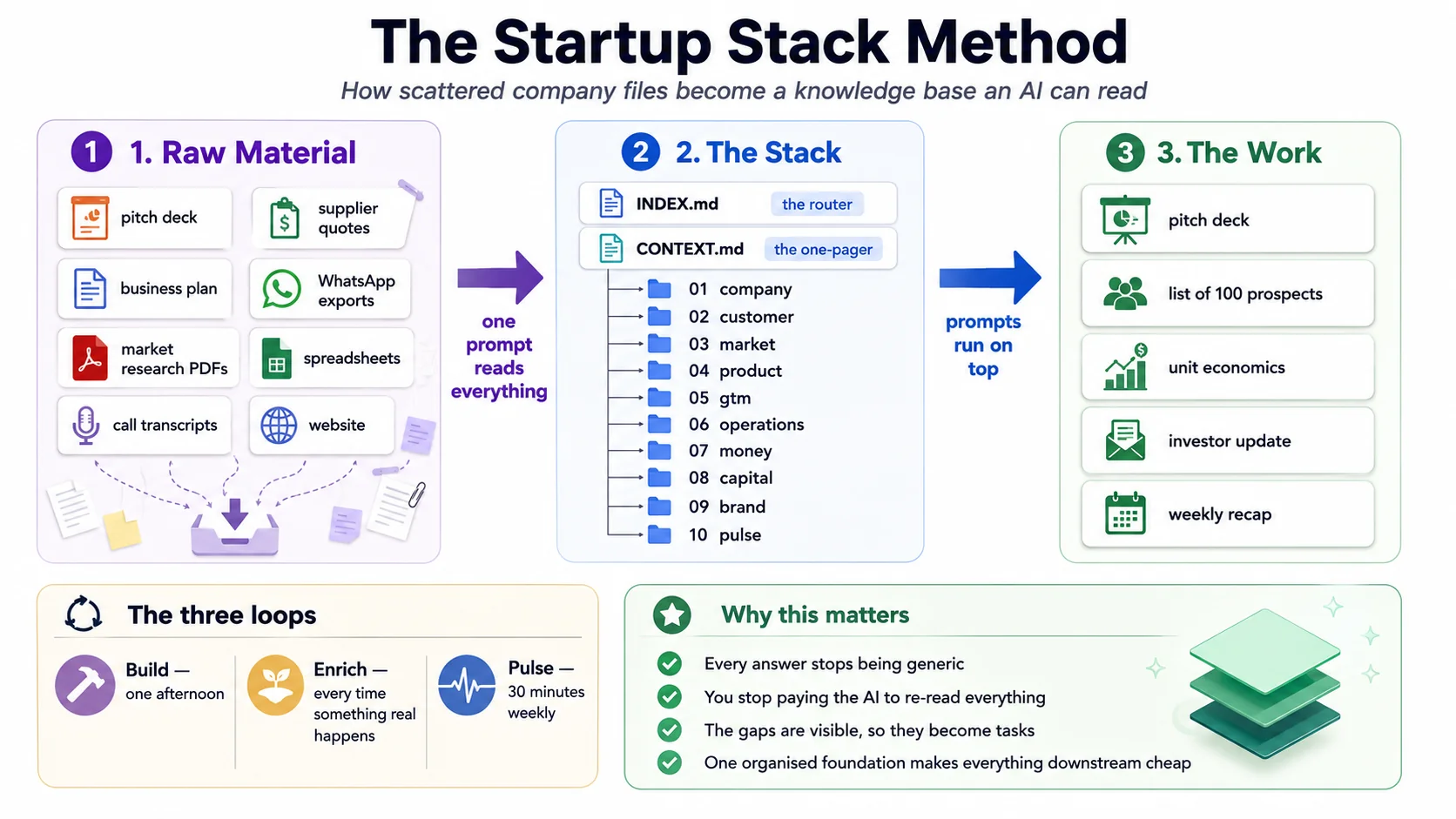
Drop your pitch deck, market research, business plan, competitor notes and call transcripts into one folder → an AI turns them into a structured, front-mattered knowledge base → then a library of prompts runs on top of it to produce the work: the deck, the list of 100, the unit economics, the weekly recap.
How it works — the five things you actually do
This is a template repository, not a product. There is nothing to sign up for and nothing to install beyond an AI tool that can see a folder.
Take a copy
Copy this repository. It becomes your company's folder — ten empty sections, front matter and prompts in place.
2Fill the inbox
Export what you already have — the deck, the plan, email threads, drive documents, call transcripts — into _inbox/. This page shows how, source by source.
Run the bootstrap prompt
Point a file-aware AI at the folder and paste one prompt. It reads the inbox and writes the stack, tagging every fact confirmed, unverified, missing or in conflict.
4Correct it
Read the one-pager it wrote. Fix what is wrong, confirm what is right. The gaps it left visible are your task list — that is the design, not a failure.
5Run the work
The recap every week, meeting-to-actions after every call, and the rest of the library — unit economics, the list of 100, the deck — when you need them.
Running this for many companies, not one
An incubator, accelerator, studio or university programme gets a layer above the five steps: one folder per company, every coaching session split into a factual record and an attributed read, and a 1-to-5 maturity level per function so you can tell which companies are stuck rather than quiet. The founder keeps their stack; you never hold a copy of it.
The problem this solves
Most early founders are carrying their company in their head and in twelve unrelated files. The pitch deck says one number, the projections say another, the market research lives in a PDF nobody has opened since March, and every AI conversation starts from zero — so every answer is generic, and the founder pays for the model to re-read everything, every time.
Meanwhile the advice they need is not exotic. It is the same twenty things, asked in the same order, by every coach who has ever sat across from an early-stage founder: Who exactly is the customer? What does a unit cost you? Who else is doing this? How many prospects are on your list — five, or a hundred? What happens when the money runs out?
startup-stack makes those questions answerable from one place.
There is a second reader, and the repo now serves them too: the programme running a portfolio of these companies — an incubator, accelerator, studio or university venture programme, whose coaching team meets the same founders in recurring sessions and whose institutional memory currently lives in scattered notes. The page written for them is the deeper end of the same method. A founder can ignore it entirely.
The three loops
Loop 1 · Build
You put raw material in _inbox/. One prompt reads it and writes the stack: ten numbered sections, one markdown file each, every fact tagged confirmed, unverified, missing, or in conflict where two of your own documents disagree. Takes an afternoon. The output is deliberately incomplete — the gaps are the point, because a gap you can see is a task.
Loop 2 · Enrich
Every real thing that happens — a customer call, a supplier quote, a rejected ad campaign, a new competitor — goes back into the stack. The base is never finished. Each addition makes the next request cheaper and better, because the AI stops guessing about your business.
Loop 3 · Pulse
Once a week, one prompt reads the stack, reads what changed, and produces a recap: what moved, what did not, what you learned, what you are doing next, and how many weeks of money you have left. That recap is the file you send your coach, your co-founder, or your investors — and it is also the file that gets read back into the stack next week.
The whole thing, drawn
Thirty infographics across four pages — what AI actually is, the tools you will hear named, this method, and the layer a programme runs on top of it. They are free to take for a workshop, a course or an onboarding pack.
653 startup resources, in one searchable table
Articles, videos, templates and tools from Y Combinator, Techstars, First Round, Paul Graham and 98 other publishers, merged from two curated collections and checked for dead links. Filter by words, narrow to a topic, sort any column. Everything is credited to whoever published it, and none of it was written here.
Where to start
You have never pointed an AI at your own files
What actually changed, what the terminal is, what the AI cannot see, and the one rule that never bends. Read this first if the rest of the site assumes something you have not done.
You are ready to build
The honest first hour: take a copy, fill the inbox, run the bootstrap prompt, and correct the one-pager by hand.
You have a stack and want the work done
19 prompts — unit economics, the list of 100, competitive intelligence, the deck, the weekly recap, and the adversarial review that tells you what an investor will attack.
You are running this with a cohort
How the method works with a group, what to expect in week one, and where founders get stuck.
Running a portfolio rather than a cohort — many companies, several coaches, and an institutional memory that has to survive any one of them leaving? That is a deeper layer: what the programme keeps for itself, why every session splits into a factual record and an attributed read, and how a maturity level routes a company to the right specialist.
The honest cost
This is what it costs, measured on a real base rather than a demo:
Skeleton in an hour. A working v1 in a few focused sessions. A stack you actually trust in about a month, because the long pole is you correcting what the AI got wrong — not the AI writing it. Then roughly thirty minutes a week to keep it alive.
Nobody should tell you this is free. The AI drafts; you validate. A stack you have not corrected is a confident-sounding guess about your own company, and that is worse than no stack at all.
The rules this runs on
- The document is the data. If a metric needs special effort to gather, it is the wrong metric. Your numbers should fall out of records you already keep.
- AI drafts, the founder validates. Nothing in the stack is true because the model wrote it. Every section carries a status tag until a human has confirmed it.
- Tag honestly.
needs-verificationandtbdare not failures — they are the quality system. A stack with visible gaps beats a polished one that quietly invents numbers. - Enrich, don't perfect. Ship the skeleton. Add to it forever.
- One index, one summary line per file. This is what keeps the base cheap: the AI reads a small router and opens one section, instead of re-reading everything you own on every question.
- Private master, shared derived. Every file declares a sensitivity. What you share with a coach, an investor or a customer is carved from the master — never the master itself.
- Scope the AI to one folder. Start narrow. Widen only as fast as your confidence. See the safety rules.
The full reasoning is in the method; the rules the AI itself must follow are in rules for the AI.