How models are made
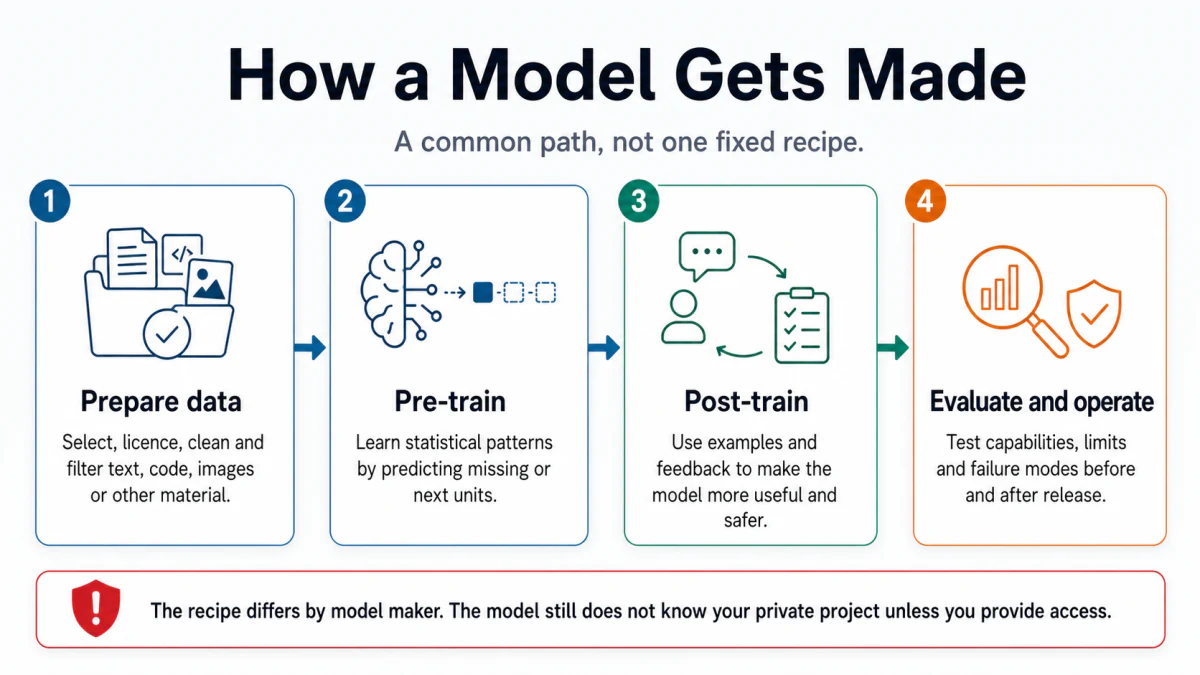
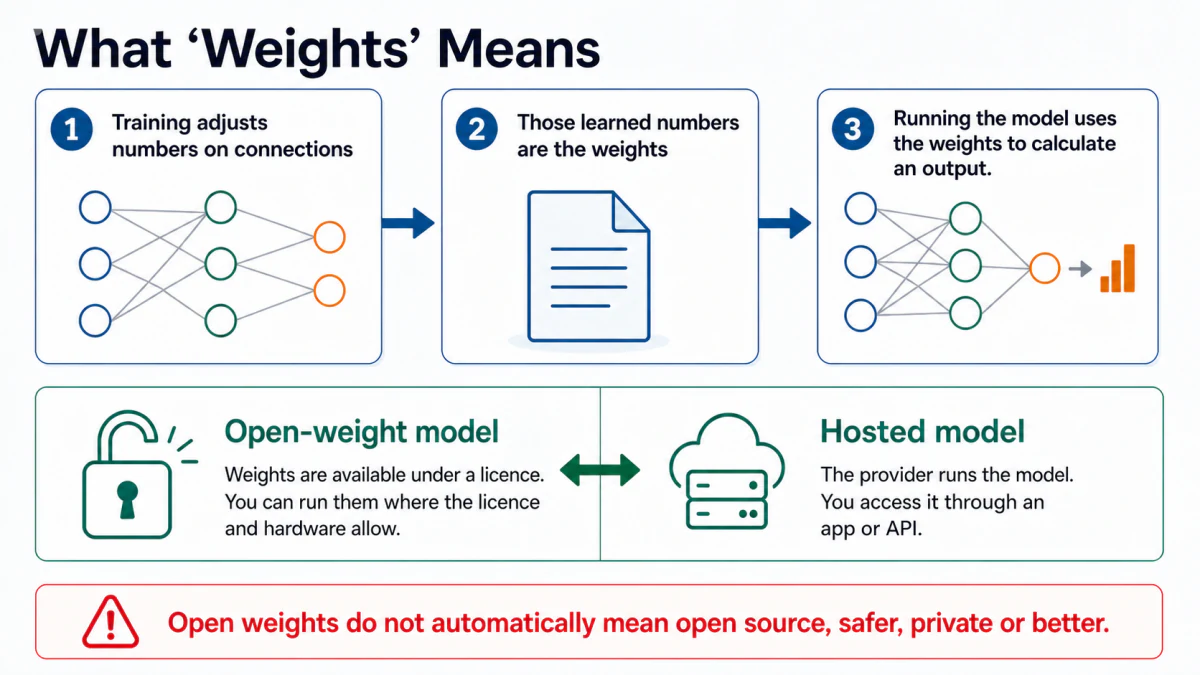
Distinguish training, weights, fine-tuning, and alignment without treating a model as a searchable document store.
Requires: The distinction between a plausible model output and sourced truth from the previous lesson.
Done when: You can place pretraining, weights, post-training, alignment, and fine-tuning in the right part of the model lifecycle and explain what none of them guarantees.
Step 0 — Check the ground
Write down the claim you are trying to evaluate. Stop if the question is really “Does this answer contain current facts?” Model training history cannot answer that; you still need a source check.
Steps
- Use this simplified lifecycle:
| Stage | What changes | What it does not guarantee |
|---|---|---|
| Pretraining | The model learns statistical patterns from training material. | A current, attributable answer to every question. |
| Weights | Numerical parameters are adjusted during training and used to produce outputs. | A row-by-row copy of the original material that you can query like a database. |
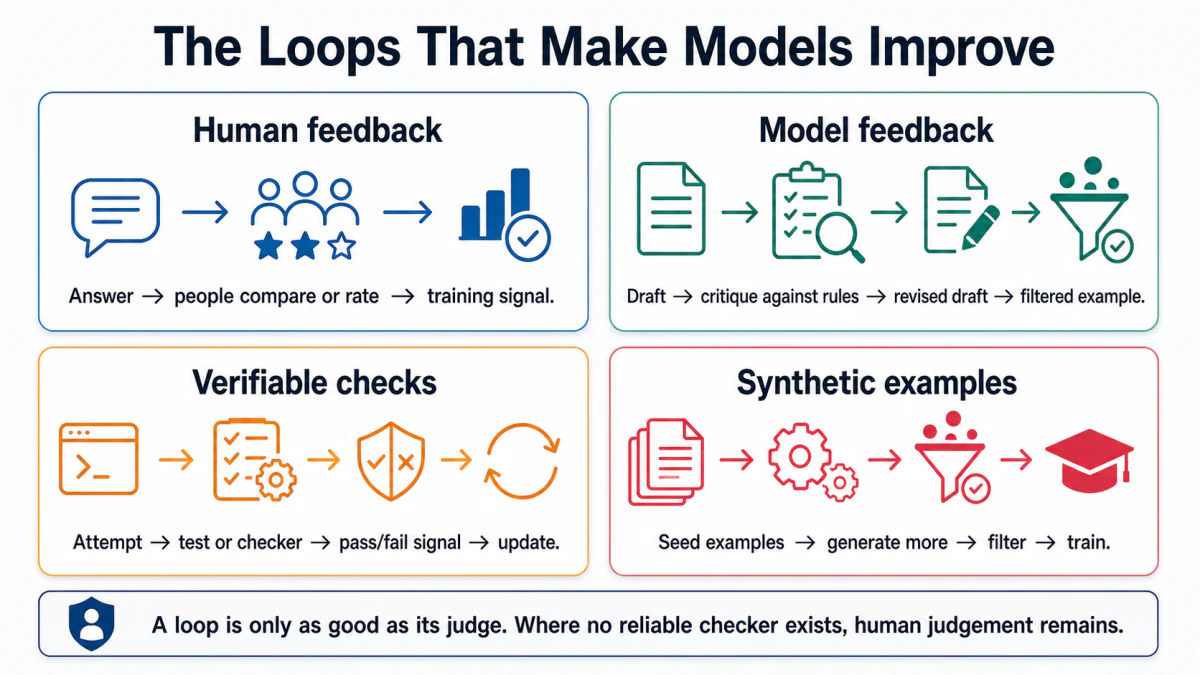
| Post-training and alignment | Training and feedback shape instruction-following, safety, and preferred behaviour. | That every output is correct or suitable for your situation. |
| Fine-tuning | Additional examples shape recurring behaviour for a defined task. | Live access to changing documents or automatic factual accuracy. |
- Separate model knowledge from working context. Training influences the model before your request. Context is the material available during this request. Tools and retrieval can add fresh material to that context.
- Separate capability from behaviour. A model may be capable of writing SQL, while your instructions, examples, tool permissions, and post-training affect how it behaves on a particular task.
- Classify each statement:
- “Put the current policy document into the request.” → context or retrieval.
- “Make this output shape consistent across thousands of examples.” → possibly fine-tuning, after simpler controls and evaluation.
- “Use a human review before a migration.” → instruction and workflow guardrail.
- “The model must already know today's price.” → unsupported assumption.
- Ask for a lifecycle explanation tied to your actual problem:
Context: I need an AI system to [describe the recurring job]. The source
material changes [how often]. The output must pass [named checks].

Explain which parts belong to:
- base-model capability,
- instructions and examples,
- request-time context or retrieval,
- possible fine-tuning,
- human or automated verification.

Do not recommend fine-tuning merely because the answer is inconsistent.
List the simpler controls to test first and the evidence that would justify
changing the model.
Approval gate
Do not choose a training or fine-tuning project from vocabulary alone. A human first confirms the recurring task, representative examples, evaluation method, source freshness, privacy constraints, and the simpler options already tested.
Verify
Explain the lifecycle to another person without using “the model stores the internet.” You pass when you can answer:
- What changed during training?
- What enters at request time?
- What must still be verified?
Save point
Save the lifecycle classification with the product decision it informs. Record uncertain platform-specific claims as questions for official documentation, not as facts.
If it fails
- You cannot tell whether information is trained or supplied: inspect the actual request, tools, and retrieved sources.
- Fine-tuning is being used as a synonym for “make it smarter”: move to prompting, retrieval, or fine-tuning.
- The problem is wrong current facts: improve source retrieval and verification.
- The problem is unsafe action: add an approval gate; training is not an authorization system.