Choose the right adaptation
Decide whether a failure needs clearer instructions, retrieved source material, or learned recurring behaviour.
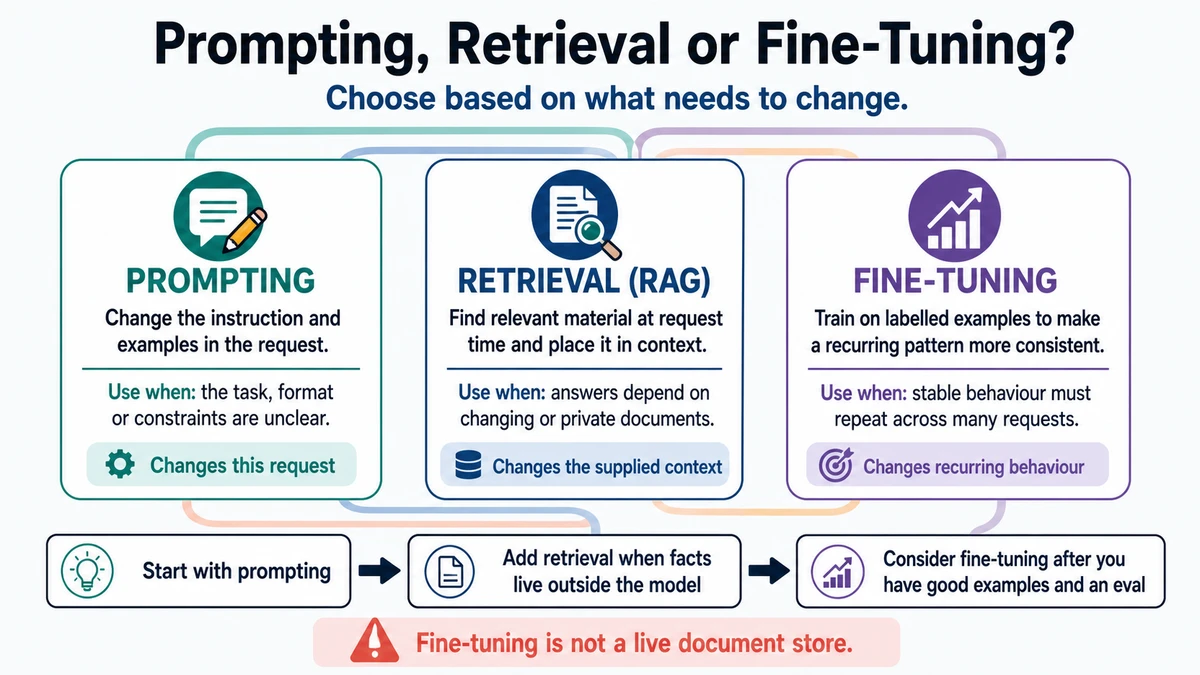
Requires: A repeated task, examples of failures, and a check that separates acceptable from unacceptable output.
Done when: You have classified the failure, chosen the least complex intervention that addresses it, and defined an evaluation before implementation.
Step 0 — Check the ground
Collect several representative inputs and outputs. Stop if the only evidence is “I did not like one answer.” You need a recurring failure pattern.
Steps
- Identify what is wrong:
- The goal, constraints, or output shape are unclear.
- The answer lacks source material that changes or is private.
- The model repeatedly behaves inconsistently on a stable, well-defined task.
- The base model lacks a required capability.
- Match the intervention:
| Intervention | Changes | Use it when | Does not solve |
|---|---|---|---|
| Prompting and examples | Instructions available for this request | The task or output contract is unclear | Missing facts or permissions |
| Retrieval, often called RAG | Source passages added at request time | Answers must use current, private, or attributable material | Poor sources or an undefined task |
| Fine-tuning | Recurring model behaviour learned from labelled examples | A stable pattern remains after simpler controls and can be evaluated | A live document store or authorization |
| Different model or tool | Available capability | The current model cannot perform the required operation reliably | Bad acceptance criteria |
- Start with the least complex option that targets the failure. Improve the instruction and source packet before building retrieval. Improve retrieval and evaluations before treating fine-tuning as a knowledge database.
- Expect combinations. A production workflow can use a fine-tuned model, a precise instruction, retrieved sources, and human review.
- Design an evaluation before changing the system. Keep the same test cases so you can compare the baseline with the intervention.
- Request a decision memo:
Context: The recurring task is [task]. Here are representative failures:
[examples]. A passing result must [checks]. Source material changes
[frequency] and is located [location].

Classify each failure as instruction, missing context, recurring behaviour,
missing capability, or verification. Compare:
1. a prompt/example change,
2. request-time retrieval,
3. fine-tuning,
4. a different model or tool.

Recommend the least complex next experiment. Include the same evaluation
set for baseline and experiment, privacy considerations, expected
maintenance, and a stop condition. Do not treat fine-tuning as live storage.
Approval gate
A human approves the failure classification, source rights, privacy boundary, evaluation set, maintenance owner, and budget before retrieval infrastructure or fine-tuning work begins.
Verify
Run the baseline and proposed intervention on the same cases. You pass when the intervention improves the named checks without introducing a more important failure.
Save point
Save the decision memo, frozen evaluation cases, baseline results, and chosen experiment. Do not overwrite the baseline.
If it fails
- No intervention wins: reconsider the task or the base capability.
- Retrieval returns irrelevant material: fix indexing, filtering, and source quality before changing the model.
- Fine-tuning looks good only on training examples: test on held-out representative cases.
- The system answers accurately but takes unsafe actions: add permissions and approval gates; this is a workflow problem.