Evals and evidence
Turn requirements into a fixed set of repeatable checks so code, prompt, and model changes can be compared rather than admired.
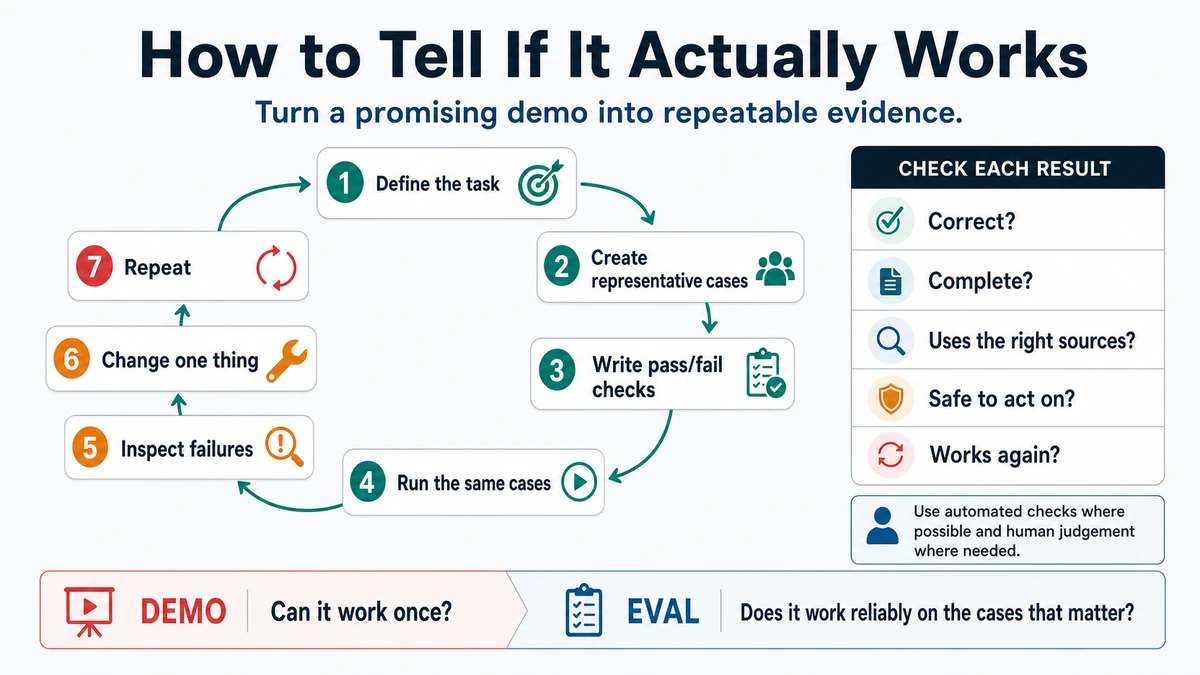
Requires: A stated user outcome or acceptance criterion and a candidate implementation.
Done when: A fixed set covers ordinary, edge, permission, and failure behavior; results identify a commit/configuration and lead to a ship, fix, rollback, or scope decision.
Step 0 — Check the ground
Stop if the only criterion is “looks good.” Ask what a user does, what result must be true, what must never happen, and what evidence another person can repeat.
Steps
- Convert each requirement into a check with input/setup, action, expected result, and evidence.
- Choose the smallest useful level:
- static/type/lint for source constraints;
- unit for deterministic logic;
- integration for boundaries;
- browser/E2E for the user path;
- human review for meaning, usefulness, and visual judgment.
- Include an ordinary case, empty/invalid case, boundary case, permission case, external failure, and regression for every serious past bug.
- For model output, define properties and unacceptable results rather than one preferred sentence. Keep a fixed input set with ordinary, difficult, adversarial, and refusal/failure cases.
- Freeze the commit, prompt, model/provider configuration, data fixture, and environment before running.
- Record failures before making changes. Change one meaningful variable where practical, then rerun the same set.
- Separate harness failure, service failure, and product failure.
- Use the evidence to decide: ship, fix, narrow scope, or rollback.
Context: Read the approved requirements and current implementation. Do not
change code or prompts.

Create a compact evaluation matrix with ID, requirement, setup/input, action,
expected result, test level, evidence artifact, and failure severity. Include
ordinary, empty/invalid, permission, service failure, and regression cases. For
model output, define observable properties and unacceptable outputs. Identify
requirements with no credible evidence.
Approval gate
The product owner approves that the set represents real usefulness and unacceptable outcomes. A technical reviewer approves fixtures, permission boundaries, environments, and what blocks release.
Verify
Give the set and build to a second person. They should reproduce the result without reading the implementation chat. Confirm every pass refers to the same commit/configuration and every failure has a disposition.
Save point
Commit durable tests and safe fixtures. Store human/browser evidence with the milestone record, including commit, environment, date, and configuration but no credentials or personal data.
If this fails
- Results vary without a code change: record environment/model/service configuration and run enough repetitions to expose the variation.
- The set grows without bound: keep release-critical checks, representative boundaries, and regressions; route exploratory cases separately.
- The team changes prompts after every single example: freeze a small set and compare changes against all of it.
- A passed test does not prove the user job: add the browser/human outcome, not more implementation-detail assertions.