Context engineering
Assemble the smallest authoritative working set—task, sources, state, constraints, tools, examples, and stop conditions—for an agent.
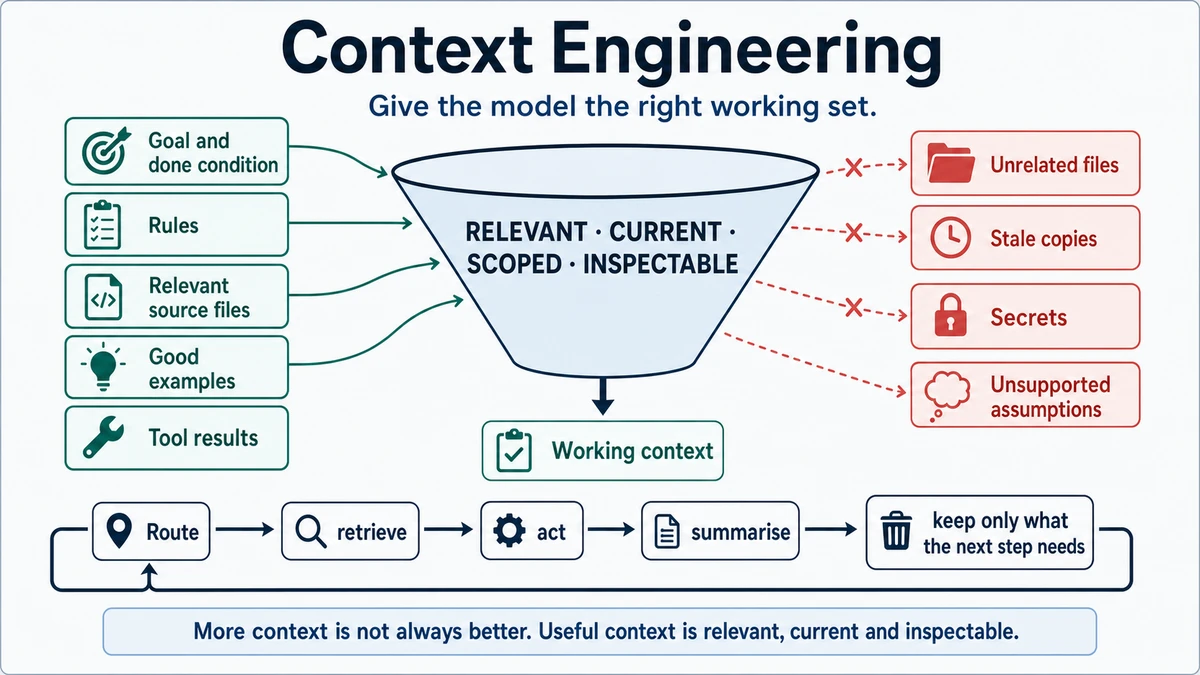
Requires: A concrete task, a project folder, and authoritative source files or known missing inputs.
Done when: An agent can state the task, sources, current state, constraints, output, checks, and stopping condition without guessing or reading the whole world.
Step 0 — Check the ground
Stop if the task cannot name an observable output. “Improve the app” is not a working target. Choose one milestone or investigation.
Steps
- Write the task and definition of done in one or two sentences.
- Route to authoritative files: governance, current PRD/brief, relevant source and tests, and the specific plan. Do not attach every old draft.
- State current state: branch/commit, passing/failing checks, environment, and known unresolved issue.
- State constraints: file scope, non-goals, data/privacy limits, approved dependencies, style, and actions requiring permission.
- Supply a small useful example when the desired shape is hard to describe. Label it as an example, not product truth.
- Name tools/actions available and those forbidden or approval-gated.
- Specify the output: plan, diff, table, test, browser evidence, or question list.
- Set a stop condition: missing input, unexpected existing change, failed baseline, target outside scope, or completed evidence.
- Ask the agent to restate its understanding and unresolved decisions before consequential work.
Task: [one concrete milestone]
Done when: [observable evidence]

Read first:
- [governance/instructions]
- [approved PRD or brief]
- [relevant source and tests]

Current state:
- commit/branch:
- known check result:
- environment:

Constraints:
- files in scope:
- non-goals:
- private data rules:
- approval-gated actions:

Produce: [plan/diff/report/test evidence]
Stop if: [missing input, unexpected change, failed baseline, scope conflict]

Before acting, restate the task, planned file scope, checks, and any human
decision you still need.
Approval gate
The human confirms that the selected sources are current, the scope is correct, private material is excluded, and the agent's restatement contains no hidden product choice.
Verify
After the result, identify which supplied context influenced each major decision. If the agent cannot point to a source or explicit choice, treat the decision as unapproved. Remove irrelevant context and rerun a small task to see whether quality stays stable.
Save point
Keep durable context in project files—PRD, plan, tests, decisions—not only in a chat thread. Commit approved context changes separately from implementation.
If this fails
- The agent guesses: add the missing source or turn the gap into a human question.
- The agent wanders: reduce to one milestone, tighter file scope, and one output.
- The context window is flooded: route with an index and short summaries; load detailed files only when needed.
- Old instructions conflict: identify the governing source and update or archive the stale one visibly.