Write the PRD
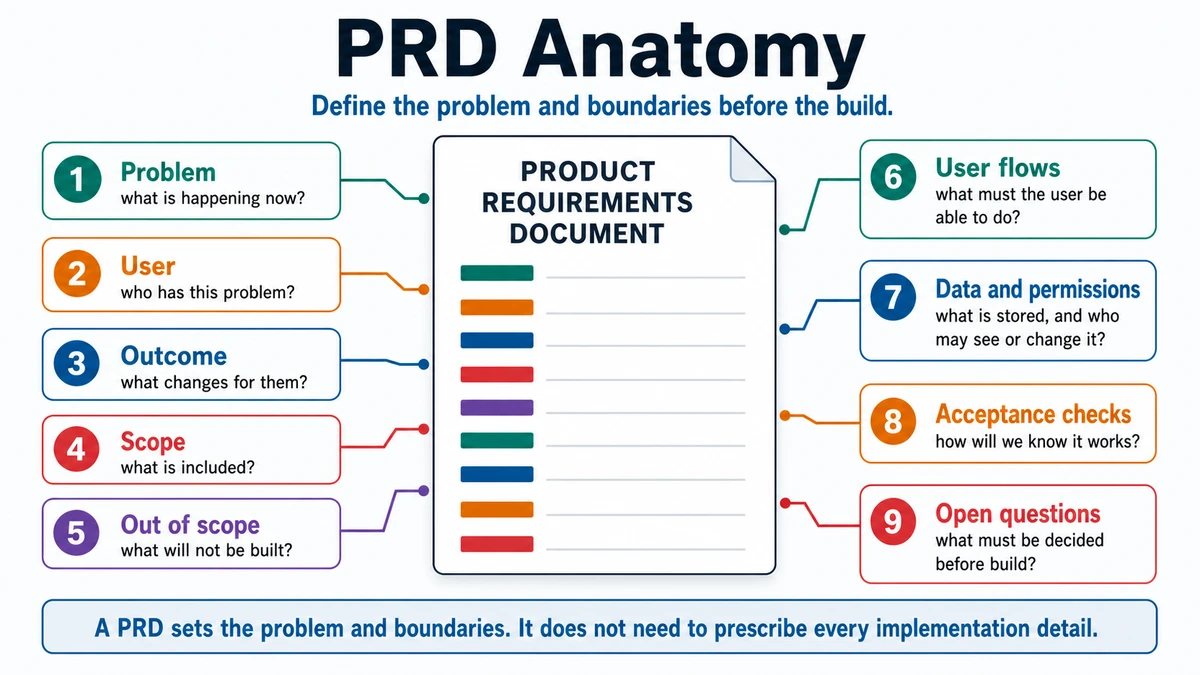
Define one learner-chosen user, job, data object, complete workflow, differentiator, and observable acceptance set.
Requires: A problem you can describe from real experience or evidence and a person who can make product decisions.
Done when: A human approves a PRD with one primary user, one job, one core object, signed-out and signed-in flows, ownership rules, a differentiator, acceptance criteria, and non-goals.
Step 0 — Check the ground
Stop if the idea is only a technology (“an AI app”) or a feature list. Name the person, their job, and the evidence that the problem exists. This course does not supply a canonical app or data model.
Steps
- Copy
prd.md. - Write one product sentence: user, job, useful outcome.
- Name the core data object in the user's language. Record its owner, required fields, and who may read, change, and delete it.
- Describe signed-out, sign-in, and signed-in flows. Include empty, invalid, unauthorized, and unavailable states.
- Define one vertical slice that completes a useful workflow from interface to database and back.
- Name the differentiator, but keep it after the ordinary protected workflow.
- Write acceptance criteria as observable Given/When/Then statements, including User A attempting to access User B's data.
- List non-goals and optional systems this release does not need.
Context: Interview me to complete prd.md for my own app. Do not propose a
sample product, schema, feature, customer, or business model.

Ask one decision-sized question at a time. Challenge vague terms with a request
for evidence or an observable example. When enough is known, draft:
- one user and job;
- one core object and ownership rules;
- signed-out and signed-in flows;
- one complete vertical slice;
- a differentiator;
- acceptance criteria and boundary cases;
- explicit non-goals and unresolved decisions.

Do not plan code until I approve the PRD.
Approval gate
The product owner reads every acceptance criterion and non-goal. They decide the product choices the prompt surfaced. A technical reviewer flags sensitive data, permission boundaries, and external systems, but does not silently change the product.
Verify
Give the PRD to someone else. They should be able to state:
- who uses the app and for what job;
- what record they create or manage;
- what a signed-out person sees;
- what User B cannot do to User A's record;
- what evidence proves the first release works;
- what is explicitly postponed.
Save point
Commit the approved PRD before cloning or changing application code: docs: approve app PRD.
If this fails
- The PRD keeps growing: choose one vertical slice and move every other workflow to non-goals.
- The core object is unclear: describe the thing the user expects to find when they return tomorrow.
- The differentiator needs AI: define the useful input/output and evaluation before choosing a provider.
- No one can approve the product choices: stop at an open-decisions list.